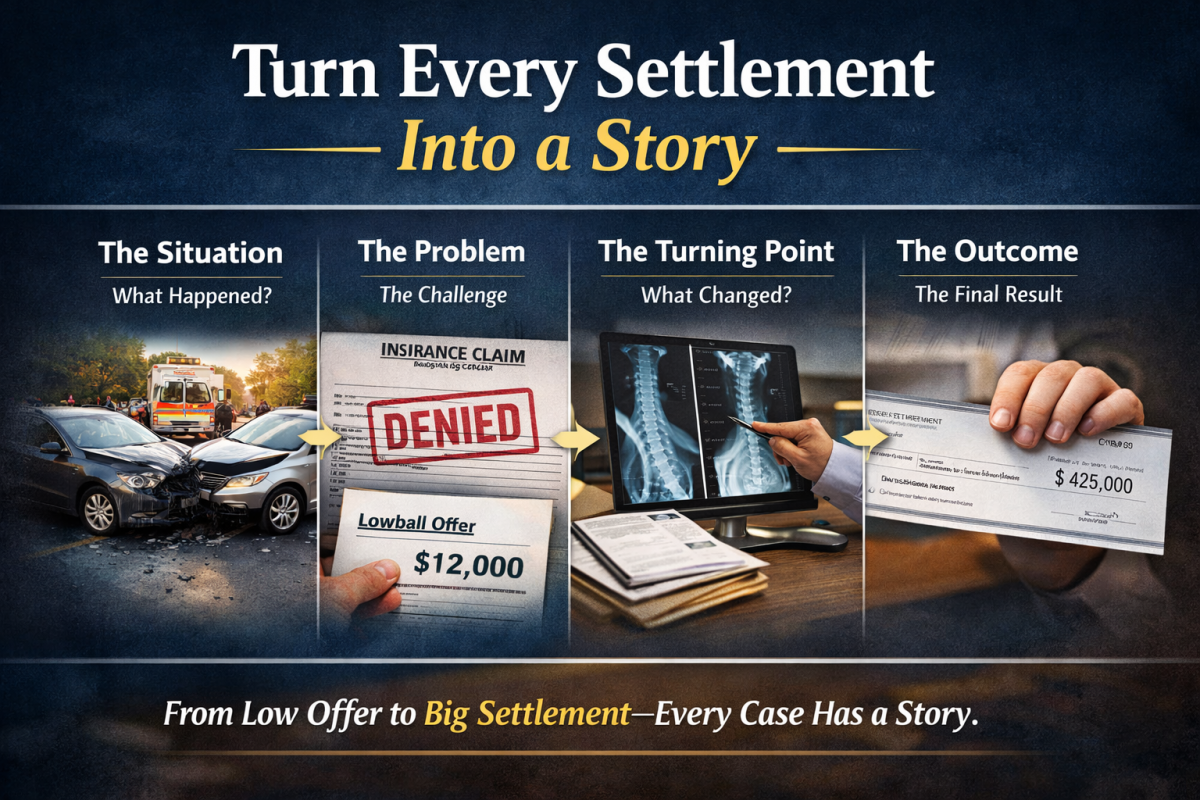
Turn Every Settlement Into a Story
Every settlement has more behind it than a dollar amount. Turn Every Settlement Into a Story shows how to transform raw case results into compelling narratives by focusing on the situation, the initial problem, the turning point, and the outcome. When settlement results are told as stories, they become clearer, more credible, and far more memorable.
Why Raw Numbers Don’t Stick
A settlement amount by itself is just a number. $250,000, $1.2 million, $85,000. Numbers lack context, emotion, and meaning. Most people don’t understand what goes into those outcomes, and without that understanding, the number doesn’t carry weight. It’s forgettable.
But the moment you turn that number into a story, everything changes. A story gives the settlement a beginning, a struggle, a turning point, and an outcome. It transforms a static result into something people can follow, relate to, and remember.
The Anatomy of a Settlement Story
Every strong settlement story follows a simple structure. You do not need to overcomplicate it. The goal is to create a clear progression that helps the reader understand not just the final result, but how that result came together. When a settlement is presented in story form, the number becomes easier to understand, more credible, and far more memorable.
1. The Situation
This is the opening of the story. It gives the reader the basic facts and creates the foundation for everything that follows. The situation should explain what happened, who was affected, and what kind of case it was. This is where you set the stage in a direct and easy-to-follow way. A strong opening does not need to be long. In many cases, one or two sentences is enough to introduce the incident. It could involve a car accident, a workplace injury, a medical complication, a wrongful termination claim, or another type of legal matter. What matters most is helping the reader quickly understand the circumstances.
This section should answer simple questions such as:
What happened?
What type of case was it?
What harm or loss did the person experience?
Why did this situation matter?
The purpose of this section is to ground the reader. Before they can care about the result, they need to understand the event that started the case. Without that setup, the settlement amount feels disconnected from reality.
2. The Initial Problem
This is where the story begins to develop tension. A settlement story becomes more interesting when the reader sees that the case was not simple, automatic, or guaranteed. The initial problem shows what stood in the way of a fair resolution. In many cases, the first obstacle is an insurance company disputing liability, minimizing the injury, or making an offer that does not reflect the seriousness of the claim. In other matters, the challenge may involve unclear evidence, inconsistent records, delayed treatment, multiple parties, or a disagreement over what actually caused the harm.
This section is important because it gives the story friction. It shows that there was uncertainty. It also helps explain why the final outcome was significant. If a case started with resistance, doubt, or a low valuation, then the eventual result carries more meaning.
Examples of initial problems can include:
- Liability being denied or contested
- The injury being treated as minor
- A low opening offer
- Missing or incomplete documentation
- Conflicting accounts of the event
- Questions about damages or causation
This is the section that makes the reader think, “This case could have gone differently.”
3. The Turning Point
The turning point is often the most important part of the settlement story. This is the moment where the case changes direction. It explains why the result improved, why the case gained strength, or why the other side had to reevaluate its position. A turning point can come in many forms. It may be a new medical diagnosis that confirms the severity of the injury. It may be surveillance footage, an accident report, witness testimony, expert analysis, or stronger documentation of lost wages and future care. In some cases, the turning point is strategic rather than factual, such as filing suit, preparing for trial, or presenting the case in a more persuasive way.
This section gives the story momentum. It moves the case from challenge toward resolution. It also helps the reader understand that settlement outcomes are often shaped by developments that happen after the initial incident.
A strong turning point often answers questions like:
- What new fact changed the value of the case?
- What evidence made the claim stronger?
- What shifted the other side’s position?
- What gave the case more leverage?
Without a turning point, the story can feel flat. With one, the outcome feels earned and understandable.
4. The Outcome
This is where the story comes together. The outcome is where the final settlement is revealed, but now the number has context behind it. The reader understands what happened, what made the case difficult, and what changed along the way. Because of that, the result feels meaningful rather than random. The outcome section should do more than simply state the final figure. It should connect the result back to the story that was just told. It should feel like the resolution of the tension introduced earlier in the case. In some stories, the outcome may show that persistence paid off. In others, it may show that stronger evidence led to a better valuation. The point is to make the settlement feel like the conclusion of a process.
A good outcome section can highlight:
- The final settlement amount
- How it compared to the initial offer
- What the result represented for the client
- Why the final outcome mattered
When written correctly, the outcome becomes more than a number. It becomes the payoff to the story. That is what makes settlement content more powerful, more relatable, and more memorable.
Example: From Offer to Outcome
Instead of saying:
“$725,000 car accident settlement”
Turn it into main points or write small paragraphs describing the incident:
- A client was rear-ended at a stoplight and initially offered $15,000 by the insurance company. The injuries were dismissed as minor, and liability was barely acknowledged.
- Over time, medical evaluations revealed a more serious spinal injury that required ongoing treatment. Documentation and expert input shifted the narrative of the case.
- The turning point came when the full extent of the injury—and its long-term impact—was clearly established.
- The case ultimately settled for $725,000.
Now the number has context. It has weight. It tells a story. Stories become memorable and people can relate to stories easier than they can to just settlement amounts.
Why Stories Change Perception
When people see a settlement amount by itself, their first reaction is often skepticism or confusion. A number alone does not explain the severity of the injury, the disputes involved, the time it took to resolve the claim, or the facts that pushed the case toward a stronger result. Without that context, the outcome can feel random, inflated, or impossible to measure against anything else.
A story changes that immediately. It gives the reader a path to follow. Instead of asking, “How did this case get to that number?” they begin to understand the sequence of events that led there. They can see the starting point, the problems that created resistance, the developments that strengthened the case, and the reason the final outcome carried value. That narrative structure makes the settlement feel grounded in real events rather than presented as an isolated claim.
Stories also make legal results more relatable. Most people are not lawyers, adjusters, or claims professionals. They do not naturally think in terms of liability analysis, damages models, medical documentation, or negotiation pressure. But they do understand conflict, setbacks, progress, and resolution. When a settlement is framed as a story, readers can follow the human side of the case more easily. They do not need to understand every legal detail to understand why the result mattered.
Another reason stories change perception is that they reveal the uncertainty behind legal outcomes. Many people assume settlement amounts follow a simple formula, but that is rarely the case. Two cases that look similar at first glance can end very differently depending on injuries, treatment, evidence, witnesses, venue, timing, and many other factors. A story helps explain those differences. It shows that the final number was shaped by a process, not pulled out of thin air.
Stories also create credibility. A bare settlement figure may grab attention, but it does not always build trust. Readers want to know what stood behind the result. They want to know whether the case involved serious challenges, whether the initial position was weak or contested, and what changed to justify the final resolution. By walking through that process, a story adds depth and legitimacy to the outcome.
Most importantly, stories make information memorable. People may forget a dollar amount, but they tend to remember the sequence behind it. They remember the low opening offer, the disputed facts, the medical finding that changed the case, or the moment the matter shifted toward a better result. Those details stay with them because stories are easier to absorb than raw data alone.
That is why storytelling is so effective in settlement content. It turns a number into a narrative, a result into a process, and a legal outcome into something people can actually understand. A story bridges the gap between confusion and clarity, helping the reader see not just what the settlement was, but why it became what it did.
The Power of the Turning Point
The most important part of any settlement story is the turning point. This is where the case shifts direction where something changes that impacts the final outcome.
It might be:
- A key medical diagnosis
- A piece of evidence
- A strategic legal decision
- A shift in liability
Without this moment, the story feels flat. With it, the story becomes compelling.
Making Every Case Memorable
Not every case is dramatic, but every case has a narrative. Even smaller settlements have a progression from incident to resolution. The goal isn’t to exaggerate. It’s to clarify:
- What happened
- What made the case challenging
- What changed along the way
- How it ultimately resolved
When you focus on those elements, even a straightforward case becomes something people can follow and understand.
From Data to Narrative
Settlement data is valuable, but stories make that data usable. They provide meaning behind the numbers and allow people to connect with the outcome.
Instead of presenting results as isolated figures, structuring them as stories creates a clearer picture of how cases unfold in the real world.
Every settlement has more behind it than a dollar amount.
When you show that process, the result speaks for itself.